

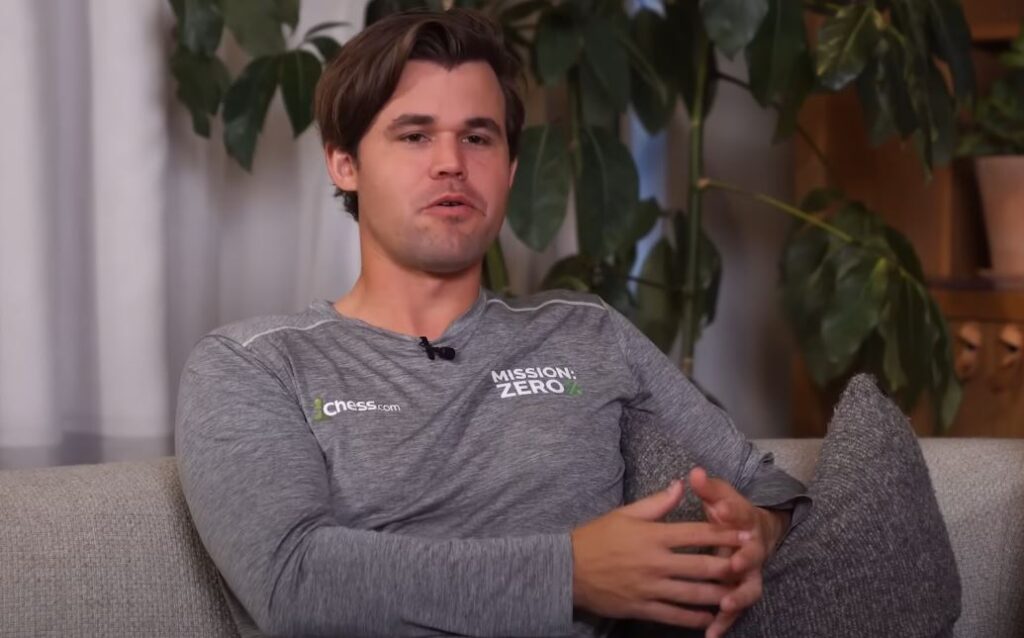
Magnus Carlsen has done a remarkable job of redefining how intelligence can lead to wealth through his ascent from a Norwegian child prodigy to a worldwide brand. Not only did he master chessboards, but he also made strategic thinking a profitable business. He was born with a calm confidence and a calculating mind. His tale demonstrates the potent coexistence of discipline and imagination and serves as a study in patience, intelligence, and entrepreneurial creativity.
Magnus Carlsen is expected to have a net worth of almost $50 million by 2025, which is remarkable for someone whose career once seemed to be restricted to trophy rooms and tournament halls. His wealth is derived from a combination of sponsorships, chess winnings, and stock in his digital business, Play Magnus, which turned his personal brand into a worldwide chess ecosystem. Carlsen’s financial situation improved dramatically when Chess.com purchased Play Magnus in 2022 in an all-stock transaction, demonstrating that his business sense was just as accurate as his tactical insight.
| Category | Details |
|---|---|
| Full Name | Sven Magnus Øen Carlsen |
| Date of Birth | November 30, 1990 |
| Birthplace | Tønsberg, Norway |
| Nationality | Norwegian |
| Profession | Chess Grandmaster, Entrepreneur, Model |
| Major Titles | Five-time World Chess Champion, Five-time World Rapid Champion, Eight-time Blitz Champion |
| Peak Rating | 2882 (Highest in chess history) |
| Estimated Net Worth | $50 million (as of 2025) |
| Company | Co-founder of Play Magnus (merged with Chess.com in 2022) |
| Sponsors | Mastercard, G-Star RAW, Unibet, Nordic Semiconductor |
Magnus has a remarkably wide range of sources of income. His Play Magnus Group, which he co-founded in 2013, was more than just a business venture; it was a cultural revolution that made chess available to millions of people online and through interactive games. Carlsen acquired a long-term stake in what is currently the most significant online chess platform when the company’s valuation reached a peak of over $100 million prior to its merger with Chess.com. This was an especially creative move that guaranteed him consistent incomes above and beyond those of conventional competitors.
Another significant source of his wealth has been sponsorships. His analytical persona became a marketable image through partnerships with Nordic Semiconductor, G-Star RAW, Mastercard, and Unibet. Through these partnerships, he transitioned from chess circuits to lifestyle audiences, establishing himself as a contemporary intellectual celebrity. He had a softer, more affable side that linked intellectualism and elegance in his modeling campaigns for G-Star RAW, most notably with Liv Tyler. His appeal has grown thanks to the collaborations, demonstrating that strategic marketing can be just as beneficial as strategy.
Even though Carlsen resigned from his 2023 classical world title defense, his tournament earnings have remained steady. He has won millions of dollars in prize money from major tournaments like the World Chess Championship, the Chess World Cup, Tata Steel, and Norway Chess during his career. He remains relevant due to his dominance in blitz, rapid, and classical formats, demonstrating that consistency is frequently more profitable than spectacle.
But timing and creativity are more important factors in Magnus Carlsen’s net worth than just numbers. He is an example of a new breed of athletes who have transformed specialized skills into profitable business ventures. His transformation is similar to that of individuals who leveraged excellence for enterprise, such as Lewis Hamilton and Michael Jordan. Carlsen excels at combining technology and intellectual property to produce value that goes beyond rivalry. He changed the game’s monetization strategy in addition to playing it.
His story also demonstrates how chess changed from being a solitary activity to becoming a popular online activity. Influencers, celebrities, and younger audiences have been drawn to platforms like Twitch and Chess.com. Carlsen positioned himself as both a beneficiary and the creator of this change by spearheading this movement early on. His insight was especially helpful because he understood that the digital age required community, brand identity, and interaction in addition to trophies.
Carlsen’s appeal has been greatly influenced by his personality. He is calm but assured, perceptive but approachable, and he has a faint sense of humor that stands in stark contrast to his intense focus during competitions. After losing to Indian prodigy Gukesh Dommaraju in the 2025 Norway Chess Tournament, he became so irate that he slapped the table, a moment that went viral. Fans were reminded of how fundamentally human even the most composed minds are. He was even more admired because of his emotional openness, which is uncommon among top chess players.
Carlsen’s portfolio is still well-diversified financially. He has made investments in media, technology, and chess instruction in addition to his business endeavors. Since its founding in 2019, his Offerspill Chess Club, which prioritizes inclusivity and talent development, has significantly enhanced opportunities for young Norwegian players. He uses his fortune to support up-and-coming artists through these endeavors, turning his success into a source of motivation. His public persona gains additional respect because of this dedication, which is both moral and practical.
Even though they are uncommon, his controversies have brought attention to his leadership in chess ethics reform. The 2022 Hans Niemann incident, in which Carlsen accused the young American player of cheating, spurred a global discussion about digital integrity and fairness. Although the episode caused controversy in the media, it also demonstrated Carlsen’s readiness to call out structural injustices. He became an unofficial reformer because of his support for transparency, a role that few intellectual sports athletes have taken so fervently.
Carlsen has come to represent how intelligence can be popular entertainment in a wider cultural context. Once written off as a niche sport, chess now attracts streaming audiences and brand sponsorships. Communities created by influencers like Levi Rozman and Hikaru Nakamura contribute to Carlsen’s ecosystem. As a result, his impact goes well beyond individual success; it supports a shared creative economy that is based on strategic thinking.
Magnus’s business sense is as logical, accurate, and strategic as his playing style. He rarely rushes; instead, he steadily gains advantages by making sure every move enhances the one before it. His career has lasted for decades without stagnating, which can be attributed to his deliberate mindset, which is especially effective both on and off the board. Through every game, every investment, and every failure, he developed a resilience-based personal philosophy.
His financial legacy continues to develop. More innovation than chess will determine whether his net worth surpasses $50 million. Carlsen’s forays into branding, gaming, and digital learning point to a larger goal: to rethink the ways in which intellectual prowess can stimulate an economy. He is successfully influencing a future in which intelligence itself is a class of assets by fusing strategy with curiosity.
