

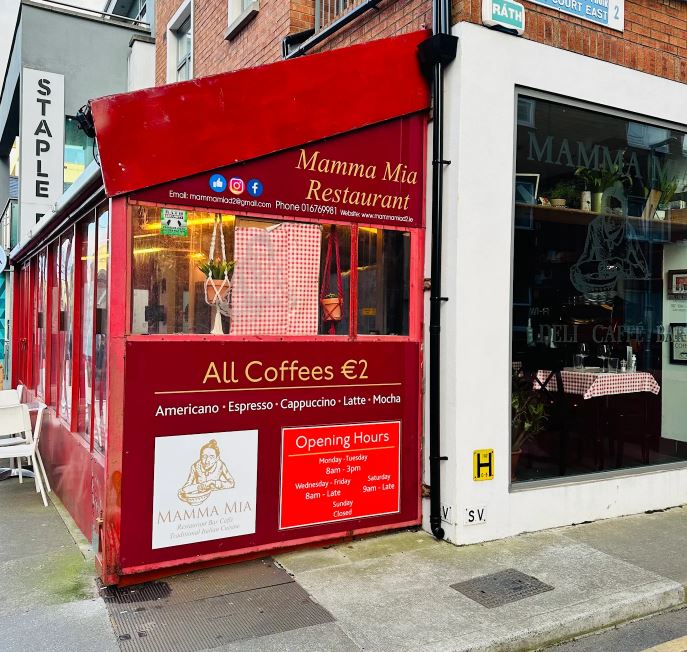
For sixteen years, Mamma Mia Deli Café Bar brought a particularly authentic Italian touch to Dublin, combining flavor and simplicity in a way that was eerily reminiscent of trattorias in Rome or Florence. Located on Grattan Street, the eatery served pizza margherita, creamy tiramisu, and wine glasses under cozy lighting, making it a haven for people looking for solace. It evolved from a dining establishment to a cultural icon where food represented memory and memory served as sustenance.
Its closure was announced in September 2025, and the sadness was particularly evident. Owners Ruth and Clint Hamilton openly stated on Instagram that the company was no longer viable, pointing to the pressures from the IPAS and IPO situation as well as a lack of government support. More than just a business note, their note was a farewell letter to a devoted community that had significantly enhanced their journey over years of gatherings, laughter, and endless pasta plates.
| Detail | Information |
|---|---|
| Name | Mamma Mia Deli Café Bar |
| Location | 2 Grattan Street, Dublin 2, Ireland |
| Cuisine | Italian – Pizza, Pasta, Deli Specialties |
| Owners | Ruth and Clint Hamilton |
| Established | 2009 |
| Status | Closed in September 2025 |
| Reason for Closure | Lack of government support, IPAS and IPO situation |
| Reputation | 4.5 stars on TripAdvisor with over 230 reviews |
| Known For | Authentic Italian dishes, cozy atmosphere, family celebrations |
Voices from customers were remarkably emotional. One regular diner wrote, “So many lovely meals had,” echoing the innumerable others who regarded Mamma Mia as a part of their own timelines. It served as the setting for graduations, anniversaries, and birthdays for families. For tourists, it served as a strikingly successful introduction to Dublin’s changing culinary identity, where Italian customs had established themselves.
The restaurant’s allure was its avoidance of ostentation. Consistency, not social media showmanship, was the key. Reviews on Tripadvisor emphasized the incredibly long-lasting quality: pizzas were characterized as perfectly thin and crisp, tiramisu that remained long after the last spoonful, and seafood pastas were hailed as fresh. With its simple décor and red-and-white tablecloths, the laid-back atmosphere served as a reminder that delicious food doesn’t have to be extravagant to be impactful.
But its closure calls into question Dublin’s dining culture more broadly. The disappearance of Mamma Mia highlights how economic pressures can drastically lower the survival chances of mid-tier restaurants, much like the demise of independent cafés in Paris or New York. Restaurant owners throughout Europe have been put to the test in recent years by inflation, staff shortages, and the cost of rent. Medium-sized businesses frequently face difficulties navigating an environment that is dominated by both expensive fine dining and inexpensive fast food, rather than quality.
It is easy to draw parallels in the context of celebrity influence. In the same way that Anthony Bourdain praised the cultural vitality of tiny, genuine restaurants, Dubliners discovered in Mamma Mia a highly adaptable setting where genuineness prevailed over fashion. It provided more substance than show, acting as a counterpoint to Instagram-driven dining experiences. In the same way that Mamma Mia was welcomed not as a “hot spot” but as a reliable gem, celebrities themselves frequently romanticize such locations. Examples include Taylor Swift’s love of family-style Italian restaurants in New York and Bono’s well-documented patronage of local Dublin spots.
Restaurants like Mamma Mia were more affected than larger chains by the shift during the pandemic, when remote work significantly decreased lunch traffic throughout Dublin’s center. Despite devoted customers, the financial burden never completely subsided, and recovery was challenging. Their experience serves as an example of how, despite its admirable qualities, resilience is occasionally insufficient when larger systems are unable to offer long-term assistance.
However, Mamma Mia’s legacy is also very effective in that it proved the enduring worth of genuineness. Dubliners referred to the restaurant as a “gem,” where the food was consistently excellent and surprisingly reasonably priced. The closure is akin to losing a friend, whose memory is engrained in the city’s collective dining history despite their passing.
At its foundation, food is a reflection of community, and for sixteen incredible years, Mamma Mia offered that reflection. It demonstrated that Dublin’s Italian food could be incredibly resilient, eclipsing fads and staying current through pure authenticity. It also served as a reminder to society that every small restaurant has lives—owners, employees, and customers all entwined in a common experience—beyond just recipes.
Dublin’s culinary scene will keep changing as new businesses open and established ones modify. However, the Mamma Mia story emphasizes that tradition shouldn’t be lost in the name of progress. In the years to come, discussions regarding sustainable dining practices must not only center on Michelin stars but also on preserving public areas that enhance daily life. The closing of Mamma Mia serves as both a cautionary tale and an example, encouraging us to value and support the places that provide us with multiple sources of sustenance.
